Friday, November 30, 2007

More Feedback From The French Laundry


One of the most frustrating things about sending people pigs is that because ours are optimal for turning into cured products, we need to be patient before we'll get real feedback. The products simply aren't ready, so nobody can eat them and say "yum". And the really fine products take longer to cure and ripen - so you have to wait longer if you are selling pigs like ours to demanding customers.

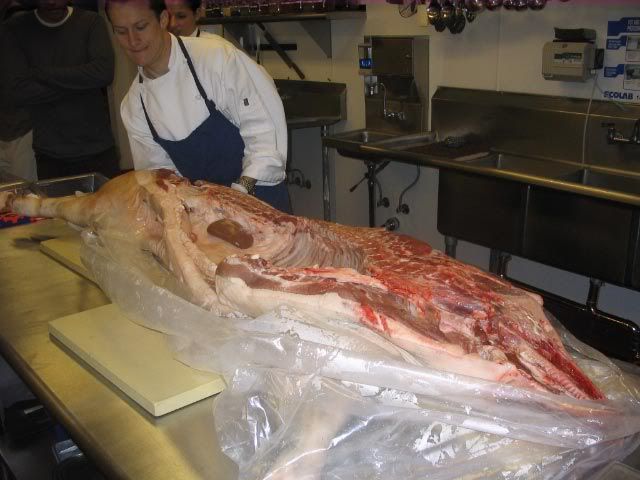
Another funny thing is that you send someone a giant pig (the photo just shows a half) - and the poor chef has to do something with it. What a daunting obligation. So you've got a guy who is stuck with a lot of work ahead of him, and you (the guy who sold it to him) are calling up, asking, "well, how is it?"

So far, the answer is something like, "I don't know yet" or "I haven't finished processing it."

So it was very nice to read this from The French Laundry's Devin Knell (Executive Sous Chef),

"I tasted some of the saucisson sec today when recuring the hams and speck, It really was excellent, it just needs a couple more weeks of age."

A peek inside Thomas Keller's Kitchen


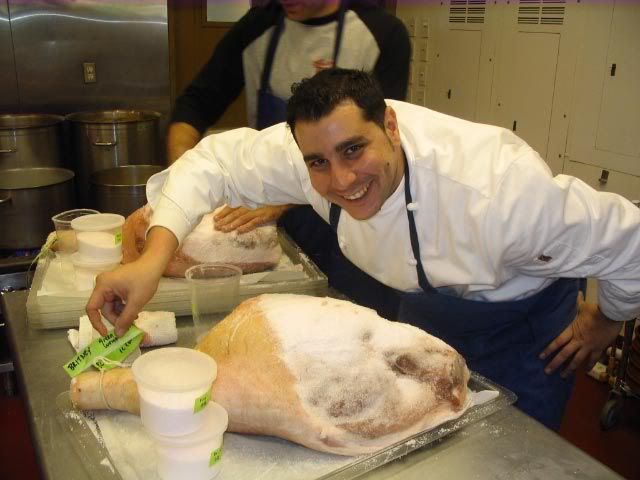
Devin Knell, executive sous chef of the French Laundry, sent me a gallery of Thomas Keller's staff working on our pigs.

You can see the pictures here (including Mangalitsa preparations) and more here. You can get some sense of how big the Berkshire hogs were here. You can see how the Mangalitsa is a bit dark here. Older Mangalitsa are darker yet.

Thanks very much, Devin, for showing us what you did with those pigs!

Monday, November 26, 2007

Mangalitsas on Small Farm

I'm busy this week, but thought people might enjoy this video.


Those are pigs on Christoph Wiesner's farm. Christoph is the President of the IGWÖ, the Mangalitsa Breeders' Association.

He's got those market hogs on a fairly small plot on his land. You can see how they are tearing it up with their rooting. There's a stump in that video. A week later, the pigs had dug it out completely. Given enough time, they'll dig up every tree you can see.

That red Mangalitsa sow has no business with those market hogs. She's supposed to be in a different area, but she broke into that area. She was terrorizing the market hogs and stealing their food.

When you keep pigs the way Christoph does, it is extremely tough to deal with exceptions and problem animals - you can't easily make that sow go back where she belongs. If the animals don't want to do what you want them to do, there's not much you can do about it.

Thursday, November 22, 2007

Mangalitsa Pigs at Feeder


Here's a video of Mangalitsa pigs celebrating Thanksgiving together at their feeder, by eating together.

These pigs are run in a family group, so there are piglets and adults together. The mostly black adult is Franz, a boar.

As they always have a feeder full of food, pretty much every day is Thanksgiving.

Wednesday, November 21, 2007

Feedback From Seth Caswell at Stumbling Goat


Although the hogs just got delivered this morning, Seth Caswell of The Stumbling Goat Bistro says that the fat from our Berkshire hogs is whiter & creamier than the hogs he's bought from other folks. He hasn't cooked it or tasted it yet - but that's the sort of thing you can see. He also said the fat on the shoulder was nearly 3 inches thick.

That's no surprise. Having studied how to fatten pigs inAustria, we know how to produce hogs with excellent fat.

If you do anything differently than we do, you'll probably not get fat as good as ours. Go ahead and feed them organic feed - but if you feed them the wrong stuff, you'll ruin the fat. Just ask Mr. Gasser (pictured above).

Franz and I Got Mentioned


Leslie Kelly mentioned Franz and me in the Seattle Post Intelligencer - along with the restaurants that just got their heavy Berkshire hogs this morning.

The article is about "wild boar" appearing in restaurants. I suspect it is popular because it is so different from normal pork. That reminds me of the feedback I got from Executive Sous Chef Devin Knell of the French Laundry, about the Mangalitsa - the fat and flavor is amazing.

Franz, pictured above, looks a lot like a wild boar. That's not surprising - the Mangalitsa breed is derived from Europe's wild boar, without any improvement from Asian pig breeds. A key difference between Mangalitsa and wild boar is that Mangalitsa are bigger and easier to manage - that's why the Hungarian breeders went through all that trouble hundreds of years ago.

Here's a nice photo of European Wild Boar (note how feminine the sow is, and how masculine the boar):


You can see the connection in the piglets. Unlike most pig breeds, Mangalitsa piglets have stripes. That's like wild boar:


Here are some wild boar piglets, for comparison:

Feedback from the French Laundry on our Pork

I got some preliminary feedback from The French Laundry's Devin Knell today.

Here's what he says about the hogs we sent them:

The baby Mangalitsa had fantastic flavor and fat development for being such a young animal, more so than a comparably aged Berkshire...

The Berkshires were great as well. Really beautiful hams with a great cushion of fat. I can't wait to taste the finished product. We also got really nice, thick slabs of back fat which we cured for lardo. With the rest we made: guanciale, reosette de Lyon, Truffled cervella, saucisson a l'ail, bauchspeck, cured and confit hearts, rendered lard, chicharon, a couple variations of pate de campagne and loin and sirloin roasts.

The only problem I had with the packaging was that I wish they would have removed the whole head before spitting and also that they cut portions of the cheek and face off the head. The way it was processed, we lost the tongue and it made it impossible to roll and braise the pig's head like we normally do. Not a big deal at all, just something to consider.


At some point, we'll have some pictures.

I'm relieved it worked out well. It is no surprise the Mangalitsa, even a piglet, had better fat than a typical pig.

His problems with the head are due to the USDA mess. We have only one plant that scalds. They are so busy right now, we can't pay them enough to do a better job on the heads.

Some Perspective

Well, I was feeling bad about not being able to sell Canadian bacon, picnic bacon or smoked fatback from my hogs - but then I read about this woman's troubles.

If you can't read that New York Times story, there's a woman accused of smuggling in bushmeat. She's looking at as much as 5 years in prison.

I'm betting the non-human primate aspect of the story is going to cause her grief. If she was just smuggling in prosciutto, there'd be folks saying, "hey, give her a break. I got busted with that too!" But monkeys and critters that look like Bambi?

Tuesday, November 20, 2007

USDA Processing Frustration - No Canadian Bacon

As mentioned previously, I want to turn a bunch of hogs into cured products so that I can resell them. That's the best use for the hogs I've got.

If I want to retail the meat, I must do USDA processing. In a two hour radius, only one processing plant can make bacon for me. So I told them to kill the hogs and make bacon out of the backs, shoulders, loins, etc.

They don't "have a label" for Canadian bacon - that is, bacon made out of pork loin. That means they can't produce Canadian bacon and put a "USDA" stamp on it, which means I can't sell it legally. I would be an outlaw if I did - like these nice folks.

So I will have some butt bacon (part of shoulder bacon), bacon (belly) and jowl bacon - but if they produce bacon from the loin, I can't sell it. Same for the picnic - they can't cure and smoke the stuff, and stamp it USDA. This diagram might help, if you don't know the hog terms.

So I told them to turn the loins into roasts. The whole thing was so disheartening. I felt like telling them to just grind all the pigs up into sausage. Even if they just had a label, "pork", I and my customers wouldn't mind. Who cares about labels, anyway?

Part of the problem is that there is only one processor in this area that will make bacon. In an area with more processors, I'd just take the hogs to the one that would do what I wanted. Here I take what I can get.

Also, as these hogs are very fat, I asked them to pack the fat, so that I could resell it. They don't have a "fatback label", nor a "leaf lard" lavel - it is just labeled "pork fat". When I asked them to pack it into roughly 5 lb units, they said that that was going to cost me extra - perhaps a lot extra - like a dollar a pound extra. I asked them to segregate the fat - but as they aren't used to doing that, it will probably all wind up in one 50 lb container.

So I hope I can find someone who wants a lot of very high quality pork fat. Were I to break the fat out and repackage it myself, I'd be breaking the law. It isn't unreasonable to use pork fat in bulk in a restaurant - this guy told me he's getting rid of butter in his restaurant, and will just use Mangalitsa lard. It tastes better and is cheaper.

The whole situation is so frustrating.

Of course, this all gets back to the superiority of custom butchering. A good custom butcher will do things your way - and it is cheaper than USDA processing. And the animals don't have to leave the farm, which saves them stress.

Our favorite custom butcher is CNJ Custom Meats, of Clayton, Washington - Curt is a very smart, conscientious butcher. We want to sell as many hogs custom as possible, and have Curt butcher them.