Friday, July 30, 2010
Foods in Season - Mangalitsa Promotion
Starting next week, Foods in Season is going to promote our Mangalitsa pork, products and those of Johnston County Hams.
Price reductions ought to allow chefs to buy most of our fresh Mangalitsa cuts at under $9.99/lb. Chefs in Seattle, San Francisco, New York and St. Louis can already acquire our pork for even less.
Stuff that costs more than $10/lb feels a lot more expensive than stuff that costs $9.99/lb or less. Foods in Season expects to sell a lot of this stuff quickly.
Johnston County Hams is the first American ham company to make a serious investment in Mangalitsa pork, and their products are only now ready. They haven't just bought the raw material and made the products. They sent their curemaster Rufus Brown all the way from North Carolina to rural New Jersey to learn directly from Christoph Wiesner.
That's a real investment of time and money.
Hence, I want to see Johnston County Hams do well selling products made from our raw material. I want to see people raving about their wonderful Mangalitsa products. Besides helping me financially, I'll feel like I haven't wasted nearly four years on something completely ridiculous: the fattest, ugliest and hairiest pigs known to man.
I've devoted a huge amount of effort to this project. A few years later, my company produces (and distributes across the USA) the best-tasting stuff in wholesale quantities, and it costs the most. If people are willing to buy the stuff at a high enough price, then I've bet correctly.
If people don't like our stuff enough to pay for it, we don't have anything to fall back on. We aren't certified this-or-that. Our pigs aren't pretty. We just produce stuff that tastes great, like the producers in Spain and Hungary.
Super-Premium
Wooly Pigs is the first company to systematically produce super-premium pork in America, starting with the pigs' genetics.
Various American companies have aped the best practices of European producers, but inevitably they have chosen to cut corners or (likely out of ignorance) they've done things that work against meat and fat quality.
I can't get more specific or I'll come off as catty. As pretty much every Mangalitsa producer in the USA has learned, it is very easy to produce outstanding pork by raising pigs with substantial Mangalitsa genetics the way we do.
Anyway, all we claim to have is the best-tasting stuff, and so far - when we get everything right - some of the most demanding customers agree that we're the best.
That doesn't mean there's any point to producing the best. If people only want to eat cheap mediocre stuff, or are only willing to pay a premium for pigs labeled "certified organic", "certified humane" or "naturally raised", there is no super-premium pork niche.
The business depends on people acting like pigs, and voting with their stomachs.
Mangalitsa fans may be surprised to hear that I ever doubt the viability of the lard-type pork market. Yet, when I see people who know better and have the resources choosing to buy mediocre meat-type pigs, I figure they are doing it for a reason; fundamentally, either they or their customers are not quality-sensitive enough.
Anyway, back to the products!
If you look at the products Johnston County Hams and Heath Putnam Farms are selling, you might think we are competing. We make speck, while they make country bacon. Both are dry-cured and smoked bellies.
I think they are very different products, because most people use them differently. E.g. I like to slice my speck thin and eat it without heating it much. Most consumers will fry up Johnston County Hams's bacon and eat it.
I hope that chefs will buy the speck AND the bacon. Certainly, if I ran a restaurant and could use both, I'd buy both.
It will be interesting to see how it all shakes out. Hopefully we'll see chefs across the USA featuring Mangalitsa on their menus, and raving about how great the cured Mangalitsa products are, whether they come from Johnston County Hams or Heath Putnam Farms.
If we get some traction with the fresh meat and the hams, maybe we can sell Mangalitsa lardo to a large number of high-end chefs, at which point I'll feel super-clever - because no other pigs in the USA produce the quality and quantity of lardo that Mangalitsa pigs produce.
Thursday, July 29, 2010
Raw Milk Cheese & Breeds
I try to keep the topic of this blog solely about Mangalitsa pigs, Mangalitsa pork and processing, but sometimes I write about other topics.
If you are someone thinking of building a raw milk dairy and making raw milk cheese (these sorts actually read this blog), what follows may interest you.
Jersey cows have a good reputation for producing fatty milk, and are relatively well-known, so some people think that getting a bunch of Jerseys and making cheese from their milk is automatically going to make their cheese the best.
It doesn't work that way.
I've got evidence (from some friends who produce some of the best cheese in the USA) that Normandes are probably better than Jerseys for cheese production. Do a little research and you'll see why.
If you are someone thinking of building a raw milk dairy and making raw milk cheese (these sorts actually read this blog), what follows may interest you.
Jersey cows have a good reputation for producing fatty milk, and are relatively well-known, so some people think that getting a bunch of Jerseys and making cheese from their milk is automatically going to make their cheese the best.
It doesn't work that way.
I've got evidence (from some friends who produce some of the best cheese in the USA) that Normandes are probably better than Jerseys for cheese production. Do a little research and you'll see why.
Wednesday, July 28, 2010
Johnston County Hams - Photos

I just got these photos from Rufus Brown (at Johnston County Hams) of their hams (made from our pork). Although they aren't on their website yet, they've sold some to special customers who've called in (1-800-543-4267).
The top shows the ham. The middle shows the bacon and the next one is the shoulder, cut into a Spanish-style paletilla.
Tuesday, July 27, 2010
Corton & Heath Putnam Farms
I got a photo of our product at Corton, in New York City.
Corton is one of the 11 restaurants in New York City that have 2 or more Michelin stars. It is famous for only cooking sous vide. Supposedly it doesn't have a normal oven. The founder is Paul Liebrandt, a really nice guy. Here's me with Paul (seated):
Paul likes to buy the sirloin. It makes a nice pavé - unlike the neck, there's not big chunks of fat in there.*
Paul is our customer because DeBragga, our New York distributor, found him, figured out what he wanted and has been telling us what to do to keep him satisfied.
Customers like Paul are the best if you want to improve your product; they'll spot any flaws, call you up, and tell you to fix it. Other customers don't necessarily notice mistakes, or if they do, they don't care enough to call and tell you what they see. It isn't easy having customers like Paul, but if you can keep a guy like Paul happy, you've probably got a very high quality product that others want too.
* That isn't to say the neck isn't wonderful: customers like The Herbfarm and Per Se, based on their purchasing patterns, prefer the neck over the sirloin.
Monday, July 26, 2010
Customer Photos
The photos here are from a customer. He's a scientist. He cooks sous vide.
A lot of scientists and engineers are good at cooking, especially sous vide.
They gravitate to Mangalitsa, perhaps becuase of its interesting properties that make it so special.
Kids Visit The Herbfarm's Pigs
Bill Vingelen from the Herbfarm sent me this video of kids visiting The Herbfarm's pigs:
Wednesday, July 21, 2010
It Doesn't Pay to be the Biggest Pig
One thing I've learned from watching pigs is that the trusting pigs typically get slaughtered first. That's bothered me, because it seems so unfair - but it is how the world works, so there's an important lesson there.
I've got less concern about the following observation: it never pays to be the fastest growing pig that bullies the others and eats their feed. Such pigs generally get killed first.
I was reminded of that today because a feeder pig customer (John Besh's La Provence) said they were going to kill their biggest pig. They need some meat for an event on short notice, so rather than ordering in Mangalitsa, they'll just kill the biggest pig and take what they need.
Their plan was to grow their pigs out to full size - but circumstances intervened. The slower-growing pigs are likely to live the longest.
I don't know if they killed their biggest pig - but as a rule, when it is time to kill N pigs, you sort them and grab the N biggest pigs. Obviously the pigs that really stand out as big are most likely to go to slaughter.
I've got less concern about the following observation: it never pays to be the fastest growing pig that bullies the others and eats their feed. Such pigs generally get killed first.
I was reminded of that today because a feeder pig customer (John Besh's La Provence) said they were going to kill their biggest pig. They need some meat for an event on short notice, so rather than ordering in Mangalitsa, they'll just kill the biggest pig and take what they need.
Their plan was to grow their pigs out to full size - but circumstances intervened. The slower-growing pigs are likely to live the longest.
I don't know if they killed their biggest pig - but as a rule, when it is time to kill N pigs, you sort them and grab the N biggest pigs. Obviously the pigs that really stand out as big are most likely to go to slaughter.
Japanese Mangalitsa Marketing

Someone is marketing Mangalitsa in Japan, in a really neat way. I find the Hungarian images done Japanese-style very striking.
I imagine that the pig on the tote is saying, "Oh no! They are going to eat me!"
They've got a cute character to represent the Mangalitsa pig. It looks a shy.
They've got meat-porn photos.
They've got cured products. Using google translation, it seems they are say it "Mangarittsua pork pancetta"If you look at their pancetta pictures closely, you can see they don't de-rib the bellies the way we do:
That stuff missing on the upper right piece of the pancetta is lean meat (and ribs) that probably got taken off as spareribs.
Heath Putnam Farms belly - deribbed, fat soft pounded out, trimmed for curing. No spareribs means there's maximal lean meat on the belly.The result is that our speck is a bit more meaty than it would otherwise be. The top surface of the speck below is mostly lean.
Monday, July 19, 2010
Lardo by Bob DelGrosso; Speck by Heath Putnam Farms - Foods in Season
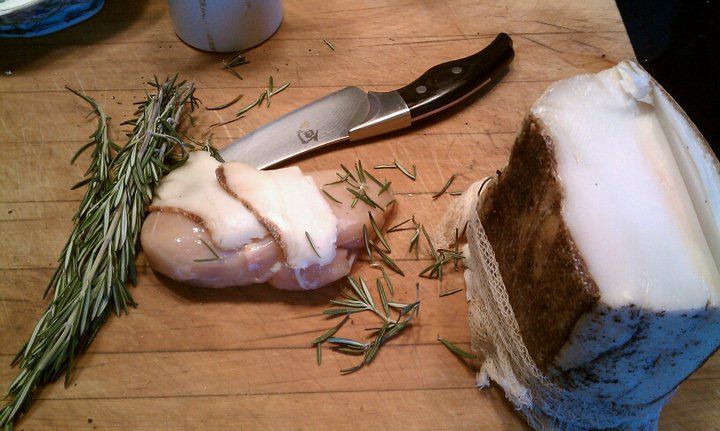
Bob del Grosso, chef, CIA instructor and Mangalitsa fan, has a beautiful picture of some lardo he made from some of Mosefund's Mangalitsa pork.
Bob understands how to use Mangalitsa pigs - one slice at a time.
It is very difficult to sell fresh Mangalitsa bellies to individuals or restaurants, but if you make them into speck or other cured products, lots of people will buy small pieces of the stuff and wrap it around dry things, like bread, chicken or fish. They'll pay a lot per pound. So you can sell a lot of belly if you process and cut it up.
One thing I've noticed in the last year is that sophisticated restaurants that sell a lot of fish and make their own bacon like Mangalitsa bellies, because they can cure them and then have great bacon to put on their relatively dry fish.
So I've just started marketing the speck through Foods in Season. Foods in Season sells a lot of fish - several thousand pounds a week - so their customers need Mangalitsa speck to make the fish taste better. They don't know it now, but after they eat their way through their block of the stuff, they ought to know it.
Subscribe to:
Posts (Atom)